
Bulletin. Series: International Relations and Regional Studies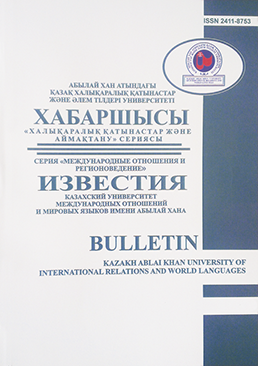
A Brief Rule for Using AI
Brief guidelines on the use of artificial intelligence for authors of the Journal “Bulletin of KazUIR&WL”
The use of artificial intelligence (AI) tools in manuscript preparation is permitted only as a supplementary aid and must not replace the authors’ scholarly contribution. The University adheres to the principle of “delegating execution, not thinking”: AI may be used to automate routine processes (such as data collection and preliminary processing, survey, and technical editing of references), but it must not substitute for critical thinking, scientific analysis, the formulation of conclusions, or the authors’ original perspective.
- Authors’ Responsibility
Authors bear full responsibility for the accuracy and reliability of the article’s content, including the correctness of data, interpretations, conclusions, citations, and references. All key arguments and scholarly conclusions must be the result of the authors’ own intellectual work.
- Transparency in the use of AI
Authors are required to disclose the use of AI tools if they were used during the research process or in the preparation of the manuscript, its sections, illustrations, or supplementary materials. This information must be provided in the section “Brief description of the research methodology,” specifying the name of the AI tool, its version, developer, purpose, and extent of use.
- Acceptable supportive application
Disclosure is not required if AI was used solely for technical assistance (for example, translating the abstract, correcting grammar and style, or formatting and preparing the reference list in accordance with the journal’s requirements), provided that the results are subject to mandatory review and verification by the authors.
- Editorial review of manuscripts
By submitting a manuscript, authors agree that the editorial office has the right to screen the text using specialized tools to detect AI-generated content. If signs of AI use are identified, the editorial office may request the original draft of the manuscript (prior to AI processing), as well as explanations regarding the purpose, extent of use, and the service utilized.
- Acceptable level of artificial intelligence usage.
The acceptable level of artificial intelligence usage in research articles submitted to the journal “Bulletin of KazUIR&WL”, as determined by plagiarism detection systems (Antiplagiat), shall not exceed 15%. If the detection system reveals a high percentage of AI usage (exceeding 15%), the editorial board of the scientific journal reserves the right to ask the authors to revise the manuscript in order to decrease the proportion of AI-generated content
- Violation of publication ethics
The submission of a manuscript in which the text has been largely generated by AI and has not undergone critical revision by the authors is considered a violation of publication ethics. If such a violation is identified, especially upon resubmission after editorial comments, the manuscript will be rejected without the right to further consideration.
- Ethical Requirements
AI tools cannot be listed as authors or co-authors and must not be considered a source of scholarly information. Authors are required to take into account potential errors and biases in results obtained through the use of AI and to verify their accuracy.
When using AI, authors must also comply with the requirements related to copyright protection, data confidentiality, and the terms of user agreements of the respective services.